How Many Sessions Before Pilates Works?
Joseph Pilates has a famous line: in 10 sessions you feel it, in 20 you see it, in 30 you have a new body. How much of that is true, and how much is slogan?
3 min read
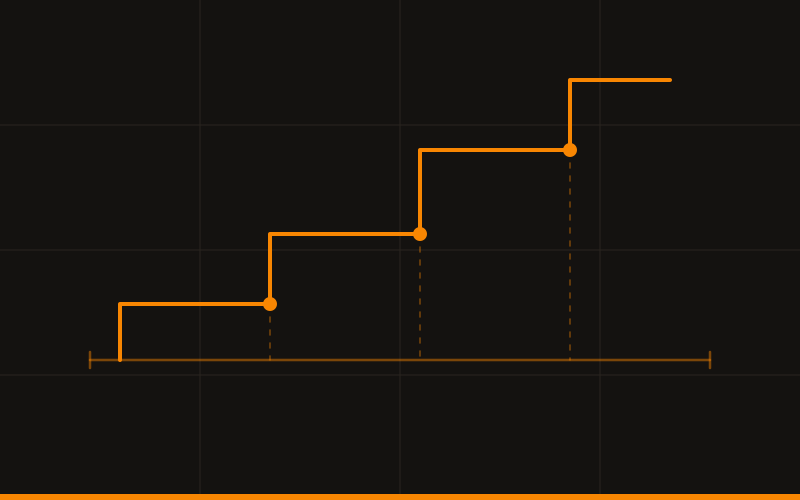
There's no single answer to this, but we won't dodge it either. Your nervous system, your muscles and your connective tissue change at different speeds. If you know which one you're waiting for, you can set the calendar.
What did Joseph Pilates say?
"In ten sessions you'll feel the difference, in twenty you'll see the difference, in thirty you'll have a whole new body." The line attributed to the founder reads like marketing, but it describes roughly the right order: first sensation, then appearance, then structure.
At two sessions a week that's around week five, week ten and week fifteen. So "thirty sessions" is about four months.
Sessions 1–4: coordination
In the first sessions your body isn't learning anything new, it's reorganising what it already has. What changes is the nervous system: which muscle fires, and when.
The sentence we hear most in this phase is "I'm doing the movement but I can't feel where it's working." That's normal. Connecting to the deep abdominals takes time, and without that connection everything after it is inefficient.
Expect: mild fatigue afterwards, soreness in surprising places. No visible change.
Sessions 5–10: sensation
Around the fifth session most people say: "I catch myself slouching at my desk." That's awareness arriving. It's actually the most important stage, because it starts to affect the other 166 hours of the week too.
Expect: noticing your own posture during the day. If you had back pain, a drop in its intensity. Doing the movements with less thinking.
Sessions 10–20: appearance
In the second month trunk control settles in. Waist measurement usually drops here: not from fat loss, but from deep abdominal tone and the pelvis changing position.
This is when clothes start sitting differently. The scale has probably not moved; we explained why in Does Pilates make you lose weight?
Expect: visible improvement in posture. Progression to harder variations. Clear ease in everyday movement.
Sessions 20–40: structure
Muscle and connective tissue take months to genuinely adapt. What you gain after the third month is more durable: it stays with you for a while even if you stop.
Expect: meaningful reduction in chronic pain. A clear difference in balance and single-leg control. More advanced equipment work.
What sets the pace?
Two people on the same programme won't progress at the same speed. What makes the difference:
- Frequency. Coming once a week doesn't give you half of what twice gives; it gives less, because the longer the gap the more each session restarts. There's detail in How many days a week should you do Pilates?
- Starting point. Someone who has been sedentary for a long time moves faster in the first weeks; someone already active moves slower but deeper.
- Life outside the studio. Sitting eight hours a day and doing two hours of Pilates is not the same as sitting six and doing the same two.
- Sleep and nutrition. Tissue repair happens while you rest, not in class.
When to be concerned
If you feel no difference after eight to ten sessions, that isn't normal. The cause is usually not the programme but the fit: the loading may have been too light, or something underneath (a sleep disorder, thyroid, vitamin D deficiency, an unresolved injury) is slowing things down.
In that case we reassess the programme, and refer you to a doctor if needed. Something working matters more than selling sessions.
One class is enough, the body tells the rest.
We assess in the first session and build the programme together. So you can see the studio and meet your instructor before joining.
- Opening hours
- Every day except Saturday, 09:00–22:00