
How Many Days a Week Should You Do Pilates?
Is one day enough? Is every day too much? What actually determines the frequency, and how to build a realistic plan.
2 min read
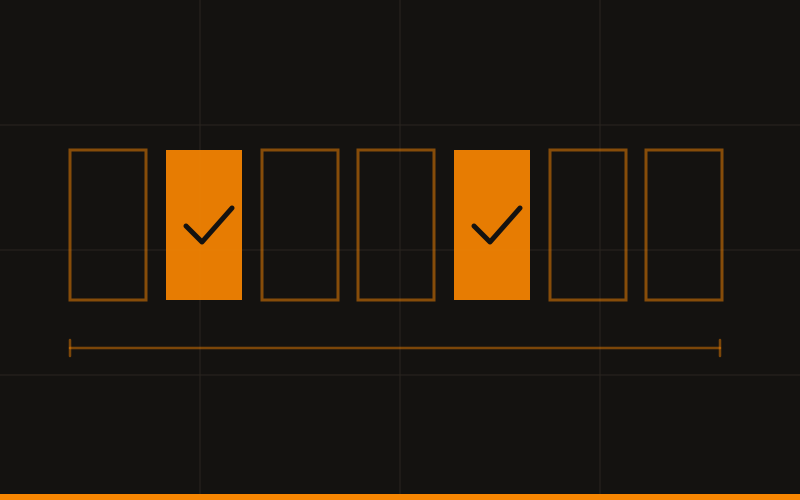
One of the most common questions. Short answer: two days a week, the threshold that gives most people steady progress.
The longer answer is more interesting.
Why two days?
The muscular and nervous systems adapt when they meet a stimulus again and again. A one-off session gives a stimulus, but if too much time passes, the system returns to where it was.
Two sessions a week keep the gap short enough. The body gets a new stimulus before it has fully lost the effect of the last one.
There’s a learning side too. Pilates movements are technical; they aren’t learned in a single day. Two sessions speed up how quickly the movement patterns settle.
Does one day work?
It does: just more slowly.
How realistic your plan is matters more than how perfect it is. Coming once a week and continuing for six months gives a far better result than planning three days and quitting entirely after two weeks.
If you train one day a week, adding a short mat sequence you can do at home speeds things up noticeably. A ten-minute home routine doesn’t replace a second session, but it fills the gap.
Three days and above
Three days is usually built for people with a specific goal: an upcoming date, a return programme after injury, or preparation for a particular sport.
There’s nothing wrong with doing pilates every day, the movements are low-impact. But the programme should be varied. Repeating the same sequence daily is both boring and inefficient. If you’re training intensively, the days are built with different focuses: core one day, spinal mobility another, lower body another.
What sets the frequency
Your starting point. The recovery time of someone who has never trained and someone who trains regularly is different.
Your goal. General conditioning and a return after injury don’t call for the same frequency.
Other activities. If you already run or lift, pilates sits alongside them, not instead of them.
Your calendar. The best programme is the one you can actually sustain.
A realistic starting plan
If you’re starting for the first time:
- Weeks 1–4: two days a week. A phase for learning the movements.
- Weeks 5–12: two days a week + a 10-minute mat sequence at home.
- After month 3: we review your situation and adjust the frequency.
This isn’t a template. In the first assessment it takes shape around your calendar and your goal.
To talk through the frequency that suits you, get in touch, the first conversation is free.
One class is enough, the body tells the rest.
We assess in the first session and build the programme together. So you can see the studio and meet your instructor before joining.
- Opening hours
- Every day except Saturday, 09:00–22:00