
Pilates and a Herniated Disc: When It Helps, When It's Risky
Can everyone with a herniated disc do Pilates? No. But for those who can, a properly built programme works far better than avoidance.
3 min read
This article is not medical advice. For anyone diagnosed with a disc problem the first step is always their doctor; the aim here is to explain what helps and what makes things worse in Pilates, once you have that clearance.
First, a distinction
"Herniated disc" isn't one condition. Cases that share the name behave very differently:
- Disc bulge: the disc pushes outward but the outer ring is intact. Usually the group that responds best.
- Disc herniation: inner material has passed the ring. If a nerve is compressed, symptoms travel down the leg.
- Nerve root compression: numbness, loss of strength, foot drop. In this group the decision to exercise belongs entirely to the doctor.
Two people with identical MRI images can live completely differently, one pain-free, the other unable to sit. That's why we build the programme around how the person moves, not around the scan.
When we don't do Pilates
We don't start sessions in these situations; we refer to a doctor:
- Progressive loss of strength (can't lift the foot, dropping it)
- Any change in bladder or bowel control, this is an emergency
- Pain that doesn't settle at rest and wakes you at night
- The early period after surgery, and anything your doctor hasn't cleared
These aren't negotiable. We don't sell sessions to someone who arrives with that picture.
What actually helps
In a cleared case, what Pilates does for the low back is this: train the muscular corset that carries the spine, so the load on the disc drops.
Three mechanisms:
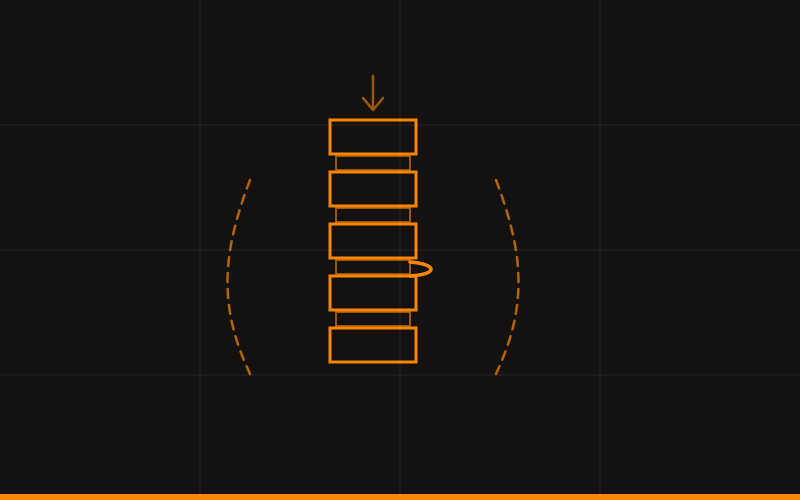
Deep stabilisers. Transversus abdominis and multifidus hold spinal segments together. When they're weak, every bend loads the disc more.
Load sharing. If the hips and back are weak, the low back covers the gap. Once the hip extensors start working, the low back's share falls.
Movement quality. Whether you hinge from the back or the hip directly changes the pressure the disc sees. That's a learnable skill.
Why the reformer, not the mat?
We start most people with back complaints on the reformer. Because:
- You can work lying down. Gravity doesn't load the spine vertically.
- Adjustable resistance. Spring load can be set where the person can carry it; on the mat the load is always your own bodyweight.
- Supported movement. The carriage constrains the direction of travel, so drifting into a bad angle is less likely.
We explained how the equipment works in What is reformer Pilates?
Movements we leave out
In the acute phase and in most disc problems, the patterns we remove:
- Loaded forward flexion and trunk curling (including the classic sit-up)
- Double leg lowering with straight legs
- Rotations that enter pain
- Deep flexion first thing in the morning, discs are at their fullest then
None of these are banned forever. As tolerance rises most of them come back; what sets the order is control, not pain.
A realistic expectation
In people arriving with back complaints, we generally see a drop in the frequency of pain in the first four to six weeks, and clear relief in everyday movement within two to three months. The MRI image doesn't change, what changes is how you live with it.
In the first session we talk about your doctor's report, where the pain sits and what triggers it. If we don't think it's appropriate, we say so plainly.
One class is enough, the body tells the rest.
We assess in the first session and build the programme together. So you can see the studio and meet your instructor before joining.
- Opening hours
- Every day except Saturday, 09:00–22:00